
What Are Core Boards? A Guide for Parents and Teachers
If your child is non-speaking, or their speech is hard for other people to understand, everyday moments like asking for a snack or joining in at the park can be frustrating for everyone involved. A core board is one of the simplest and most effective tools for opening that up.
What is a core board?
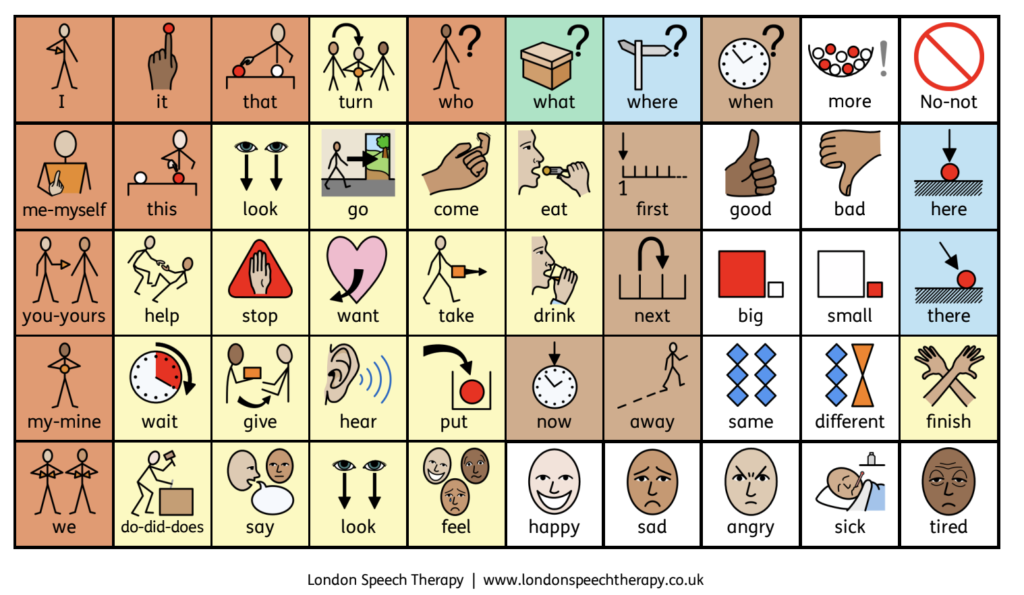
Core boards are a form of Augmentative and Alternative Communication (AAC), the umbrella term for any method of communicating that supports or replaces speech. They give a person a set of essential words and phrases that come up constantly in everyday conversation, so they can request, comment, make choices and take part.
Core boards typically include a selection of high-frequency words with corresponding pictures: pronouns (I, you, he, she), verbs (want, go, like), prepositions (in, on, under) and other everyday items. Many follow the same colour structure as Colourful Semantics, where orange is people, yellow is actions and verbs, green is items and objects, and blue is places.
Boards can also include a ‘fringe vocabulary’: words personalised to the individual user, or to a particular activity. One child’s fringe vocabulary might include ‘Mary’ (mum), ‘George’ (dad), ‘Lily’ (sister), ‘bubbles’ (favourite activity) and ‘ice cream’ (favourite treat). A fringe vocabulary built for a Mr Potato Head activity would instead include ‘arms’, ‘ears’, ‘red’ and ‘hat’.
How do you use one?
Core boards help someone develop their communication, rather than replace it. That development happens through modelling: the adults around the child using the board themselves, out loud, as part of ordinary conversation.
Keep the board easily accessible and use it across as many contexts as you can, at play, at bath time, at the park, so your child is taking part in communication as much as possible. After all, it is their voice.
One thing that is easy to get wrong: do not move the icons around. Just like a mobile phone, AAC relies on visual and motor memory. Imagine if someone rearranged all of the icons on your phone overnight, and how frustrating and slow the next few days would be. Keeping the layout consistent is what allows a child to get faster and more confident.
Why do core boards help?
Core boards let a child make choices, express preferences and take part in activities independently. They also support social interaction, by giving a child the practical tools to hold a conversation, share a thought and connect with the people around them.
Using core boards in the classroom
Almost every activity in a school day depends on being able to communicate, so a pupil who is non-speaking or whose speech is unclear can find ordinary classroom participation exceptionally hard. Core boards are a low-tech, low-cost way for teachers and Special Educational Needs (SEN) staff to change that.
A few things make the difference in a classroom:
- Keep the board within the pupil’s reach at all times, not in a drawer or a folder.
- Model it yourself, in everyday conversation, not only in structured sessions.
- Build a fringe vocabulary for the lesson or activity, so the board can carry the actual content of the task.
- Use it in unstructured time too: break, lunch and transitions between lessons.
- Keep the layout identical across every copy of the board that pupil uses.
If you are thinking about communication support across a whole setting rather than for one pupil, our speech and language therapy for schools team works in partnership with schools across London, Kent and Essex, and our training includes AAC for whole staff teams.
Where to go next
If you would like to try a core board before committing to anything, AssistiveWare offers free downloads.
If you have concerns about your child’s communication, visit your GP, who can refer you to your local NHS service. You can also contact us to be seen privately: email enquiries@londonspeechtherapy.co.uk or call 020 3475 2189. You can read more about how we work with children on our speech and language therapy for children page.
You may also find our guide to using Makaton helpful, as the two approaches are often used alongside each other.
