


Autism Assessment: What Schools Need to Know Before Making a Referral
A parent asks for a meeting. They’ve been reading, they’ve been worrying, and they want to know whether you think their child might be autistic. Or it’s the other way round: you and the class teacher have been wondering for two terms, and nobody is quite sure how to start the conversation.
Either way, the school can play an important part in an autism assessment. What you observe, record and share helps build a fuller picture of the pupil, because a diagnostic team cannot see a child across a school day and you can.
This article sets out what that role involves, what an assessment may include, and what schools can do while families wait.
What schools contribute, and what they don’t
Schools do not diagnose autism, and it’s worth being clear about that with families from the outset. What schools provide is evidence, and it can be an important part of the assessment.
An autism assessment considers how a person communicates and experiences the world across different settings. A clinic appointment provides information about one setting on one day. School can offer observations across lessons, breaktimes, transitions, assemblies, group work and unstructured time. Diagnostic teams may ask for school information because it helps them understand how the pupil experiences different situations and what support may be helpful.
What the assessment involves
An autism assessment should follow recognised clinical guidance, including the NICE guideline on recognition, referral and diagnosis. Depending on the pathway and the individual, the team may include professionals such as a clinical psychologist and Speech and Language Therapist.
In practice, an assessment may include an initial appointment to discuss concerns, a detailed developmental history with parents or carers, direct assessment with the child, and information or observations from nursery or school. The exact process varies according to the service and the pupil’s needs.
Recognised assessment tools may include the ADOS-2, ADI-R and DISCO. The tools used will depend on the clinician, the referral question and the assessment pathway. These tools contribute to the clinical picture; no single tool or checklist should be used in isolation to determine whether someone is autistic.
If a school observation is offered, take the opportunity to share your everyday knowledge of the pupil. It can provide useful context about how they communicate, engage with others, respond to change and experience the school environment.
This is where schools often worry they will get it wrong. Your role is not to reach a conclusion about whether a pupil is autistic. It is to describe what you observe, what you have tried, and what appears to help. The assessment team can then consider that information alongside the family history and clinical assessment.
The evidence schools should be gathering
Good school evidence is specific, dated and descriptive. It records what happened rather than assuming what it means.
- Social communication across contexts: How does the pupil interact one to one, in a small group, with adults, with peers and during unstructured time? Differences between contexts may be particularly informative.
- Communication style: How does the pupil use and understand language? Consider whether they interpret language literally, use scripted or repeated phrases, or communicate in ways other than speech.
- Responses to change and sensory input: Record what happens around transitions, changes of plan, noise, the dining hall, assemblies, school trips, uniform and lighting.
- Interests and strengths: Record the pupil’s interests, areas of expertise, what engages them and what they choose to do when given free choice. These belong in the record as much as areas where support is needed.
- What has been tried: Note adjustments made and what happened. This helps the team understand the pupil’s needs and what supports their participation.
- Dates and frequency: A pattern described as “sometimes” is less useful than one described as “three or four times a week, mostly at transitions, since September”.
Be careful with interpretation. Record that a pupil left the hall during assembly and returned when it was quiet. Avoid recording only that they “couldn’t cope”, which is a conclusion rather than an observation. Include the context and what helped.
Referral routes and waiting times
NHS referral routes for children vary by area and may involve a GP, paediatrician or local neurodevelopmental pathway. School information can help families and clinicians understand the concerns, but the route should be checked locally.
Waiting times for NHS autism assessments can be long, although they vary between areas and change over time. It is helpful to be honest with families about the local pathway and to direct them to current information rather than promise a particular timescale.
Families can also choose a private assessment. If they are considering this, encourage them to check the provider’s clinical qualifications, assessment process, professional registration and how the team gathers information from home and school. They may also want to ask how the assessment follows recognised guidance and what the report will include.
Schools should explain the available routes without making families feel that they must pay privately to secure support. A family’s financial circumstances should not determine whether a pupil receives appropriate adjustments in school.
Supporting the pupil while you wait
A pupil does not need an autism diagnosis to receive support. Waiting for a diagnostic outcome before making reasonable classroom adjustments can mean a child continues to find school unnecessarily difficult.
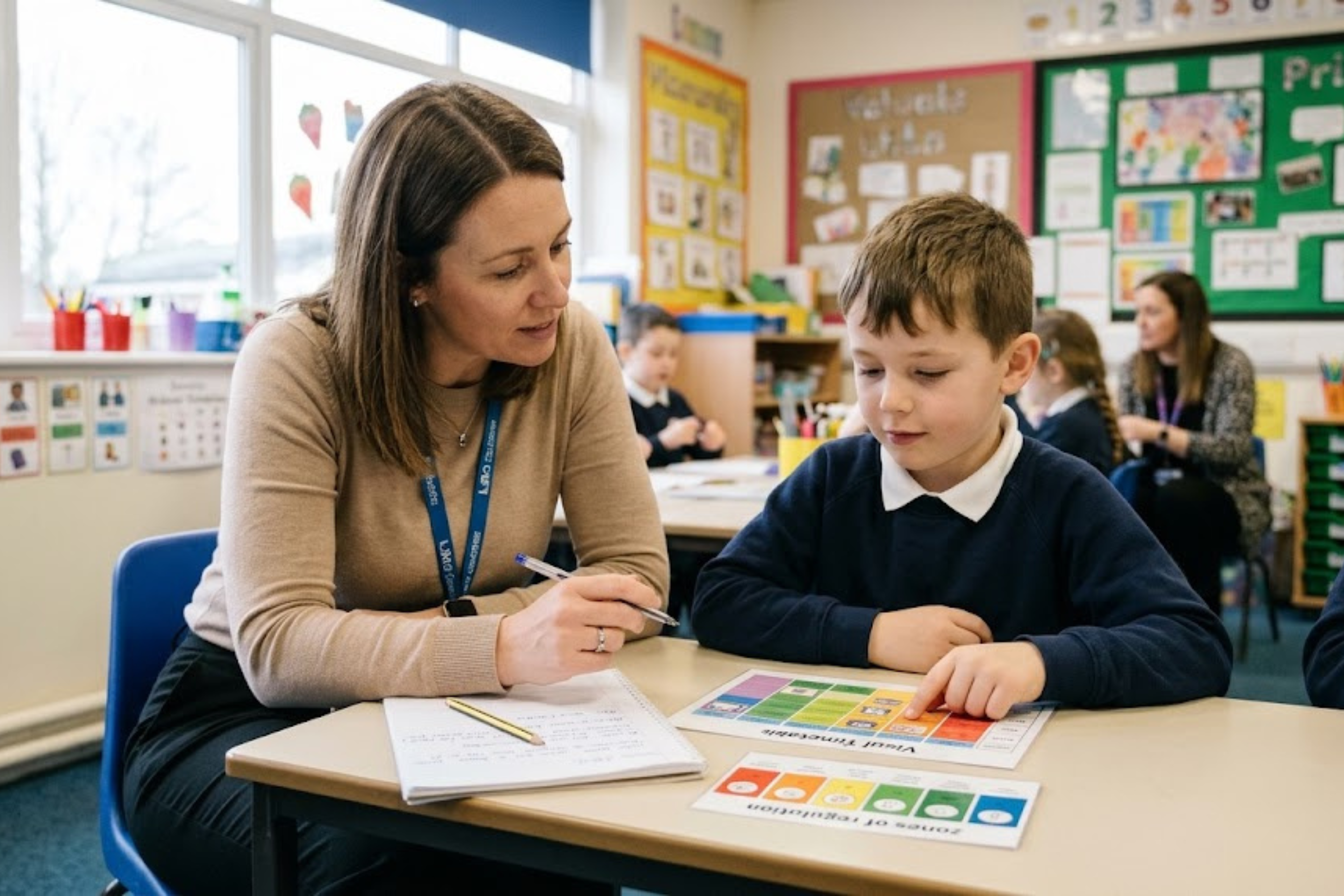
Consider what might help this particular pupil. Predictable routines, advance warning of changes, visual timetables, reduced sensory load, clear language, time to process information, access to a quieter space and genuine attention to their interests and strengths can all be useful. The best adjustments will depend on the pupil, so involve them and their family in understanding what works.
These approaches can support a pupil whether or not they later receive an autism diagnosis. They are ways of making the environment more accessible, not a test of whether a pupil is autistic.
Talking to families
These conversations tend to go better when they’re early, specific and open. Describe what you see, ask what the family sees at home, and be clear that you are not diagnosing anything.
Language matters here. Many autistic people and autistic-led organisations prefer identity-first language, such as “autistic child” rather than “child with autism”. Preferences differ, so follow the language the pupil and family use. Avoid functioning labels such as “high functioning” or “low functioning”, which can hide the differences between someone’s strengths and support needs. Describing the specific support a pupil needs is usually more useful.
Some families will welcome the conversation with relief. Others will need time. Both are reasonable responses. The school’s job is to keep the conversation open and continue supporting the pupil regardless of whether or when an assessment takes place.
London Speech Therapy provides autism diagnostic assessments for children and adults through a specialist multidisciplinary team. Assessment may include tools such as the ADOS-2, ADI-R and DISCO, alongside developmental history, clinical assessment and school information where helpful. We also support autistic pupils in schools across London, Kent and Essex. Email enquiries@londonspeechtherapy.co.uk or call 020 3475 2189.
