
Makaton Explained, and How to Implement It in Your School Setting
Almost everything we do involves communication of some kind, from asking for a drink to taking part in a lesson. When we speak, we naturally add extra tools to help the other person understand us: if someone asks for directions, we point, or sketch the route. Those are clues, and they carry real information.
What is Makaton?
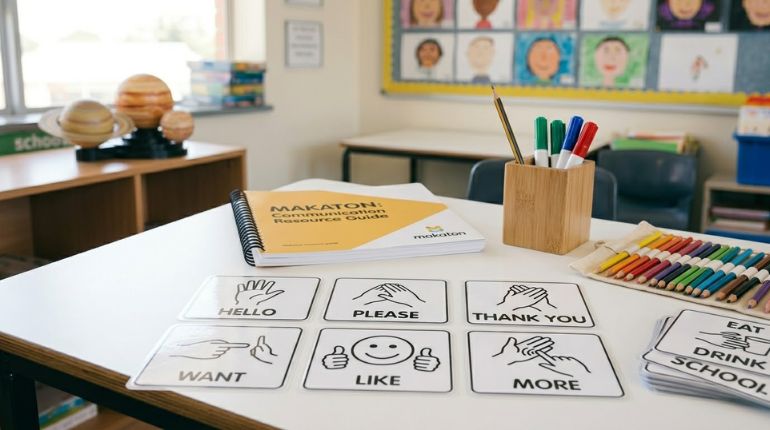
Makaton is a language programme that combines signs, symbols and spoken words to help people communicate. It works by providing extra visual clues about what a person is saying, alongside facial expression, eye contact and body language.
Importantly, Makaton is designed to support spoken language rather than replace it. The signs and symbols are always used together with speech, and follow standard spoken word order.
How is Makaton different from British Sign Language?
British Sign Language (BSL) is a naturally evolving language in its own right, with its own grammar, word order and regional variations. Makaton was created specifically to support hearing people with learning or communication differences, and stays consistent across the country in which it is used. The two are not interchangeable.
Why Makaton helps
One of the main advantages of Makaton is its flexibility. It can be personalised to an individual’s needs and used at whatever level suits them, which makes it particularly effective with children.
When a child cannot make themselves understood, the result is usually frustration, and distress often follows. Makaton removes a large part of that frustration by giving them a clear, accessible way to connect with the people around them. It allows users to share their thoughts, make choices and express how they feel. It also tends to build confidence, and children frequently start using it more creatively than the adults expected.
Implementing Makaton in a school setting
Almost every activity in a school day relies on a pupil’s ability to communicate. For children who have no speech, or whose speech is highly unclear, standard classroom interactions can be a source of constant frustration. Makaton is one of the most practical ways for schools and Special Educational Needs (SEN) teams to change that.
A few things make implementation work:
- Train the whole team, not one person. If only the teaching assistant signs, the pupil can only communicate with the teaching assistant.
- Start with a core set of signs tied to the school day: more, finished, help, toilet, lunch, playtime, and the names of key adults.
- Sign and speak together, every time. Makaton follows spoken word order and is meant to accompany speech.
- Use it beyond the classroom: at break, at lunch, in assembly. Communication that only works in one room is not communication.
- Teach the peer group too. Pupils pick up signs quickly and are usually keen, and it removes the isolation that comes with being the only child in the room who signs.
By building Makaton into daily routines, staff can make sure children with speech, language and communication needs (SLCN) have a reliable way to communicate and take part in their education.
Getting support
We have seen the difference Makaton makes for children and adults, and we deliver Makaton and AAC training for whole staff teams as well as for parents.
If you are a school, our speech and language therapy in schools team works in partnership with settings across London, Kent and Essex. If you are a parent, you can read about our work with children on the speech and language therapy for children page, or speak to your GP about an NHS referral.
To talk to us directly, email enquiries@londonspeechtherapy.co.uk or call 020 3475 2189.
Makaton is often used alongside other low-tech AAC. Our guide to core boards covers the most common of these.
