
Supporting Non-Speaking Pupils: An Introduction to Core Boards
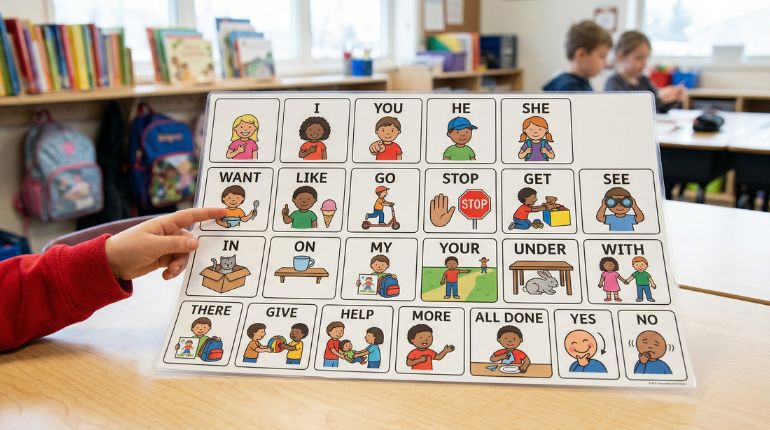
For pupils who are nonspeaking or have unclear speech, participating in daily classroom activities can be exceptionally difficult. To support these pupils, teachers and Special Educational Needs (SEN) staff can use core boards, which are a highly effective, low tech form of augmentative and alternative communication (AAC).
What is a Core Board? A core board provides a set of essential words and phrases that are frequently used in everyday communication. These boards typically feature a selection of high-frequency words alongside corresponding pictures, allowing a pupil to point to words such as pronouns (I, you, he, she), verbs (want, go, like), and prepositions (in, on, under).
To make these boards easy to navigate, many follow the exact same colour structure used in the Colourful Semantics approach. In this system, different types of words are categorised by colour: orange for people, yellow for actions or verbs, green for items or objects, and blue for places.
Alongside the high-frequency ‘core’ words, teachers can add a ‘fringe vocabulary’ to the board. Fringe vocabulary consists of specific words that are personalised and relevant to the individual user or a particular classroom activity. For example, a student’s personal fringe vocabulary might include the names of their family members or a favourite treat, while a fringe vocabulary designed for a specific lesson, such as building a Mr. Potato Head, would include words like ‘arms’, ‘ears’, ‘red’, or ‘hat’.
Practical Application in the Classroom
It is important to understand that core boards are designed to help a user develop their communication skills, rather than replace them. However, pupils will only learn to use these boards successfully if teachers, assistants, and other caregivers actively model how to use them.
When introducing core boards into the classroom, they must be easily accessible to the student at all times and integrated into the everyday environment. Teachers should encourage the use of the boards across various contexts, such as during play, break times, or structured lessons, so the pupil is participating in communication as much as possible.
** ADDITION **Just like our mobile phones, AAC supports pupils in utilising visual and motor memory. Therefore, it is important that we do not move around icons on AAC. Imagine if someone suddenly moved around all of the icons or letters on your mobile phone. How frustrating and difficult that would be.
By providing a consistent and structured way to communicate, core boards allow individuals to make choices, express their preferences, and participate in classroom activities independently. They also support social interactions by giving students the practical tools they need to engage in conversations, share their thoughts, and connect with their peers.
